
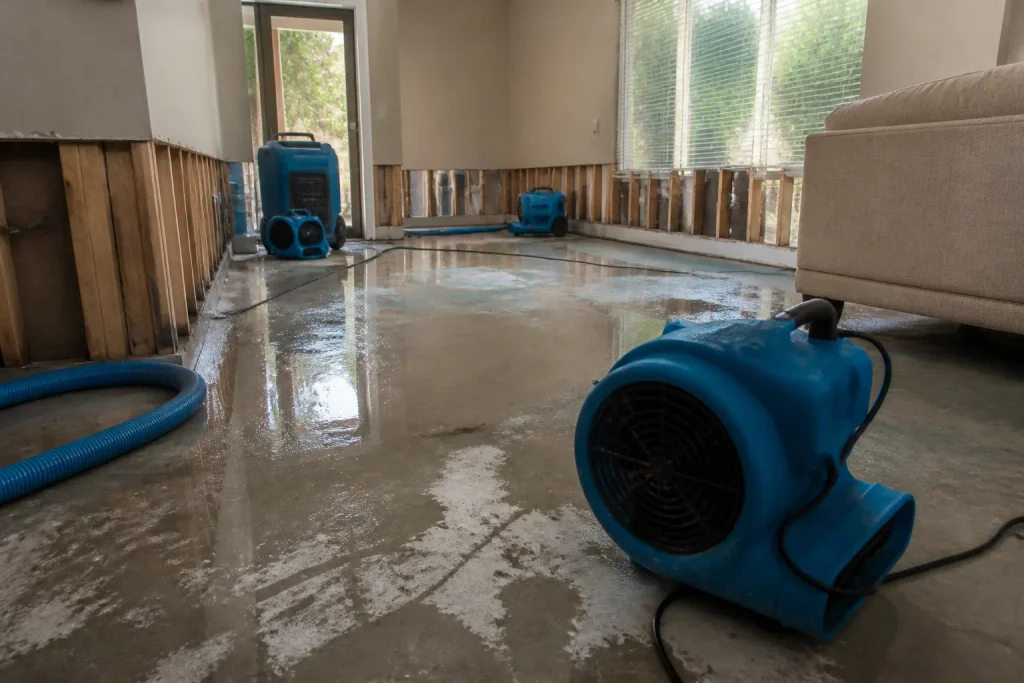
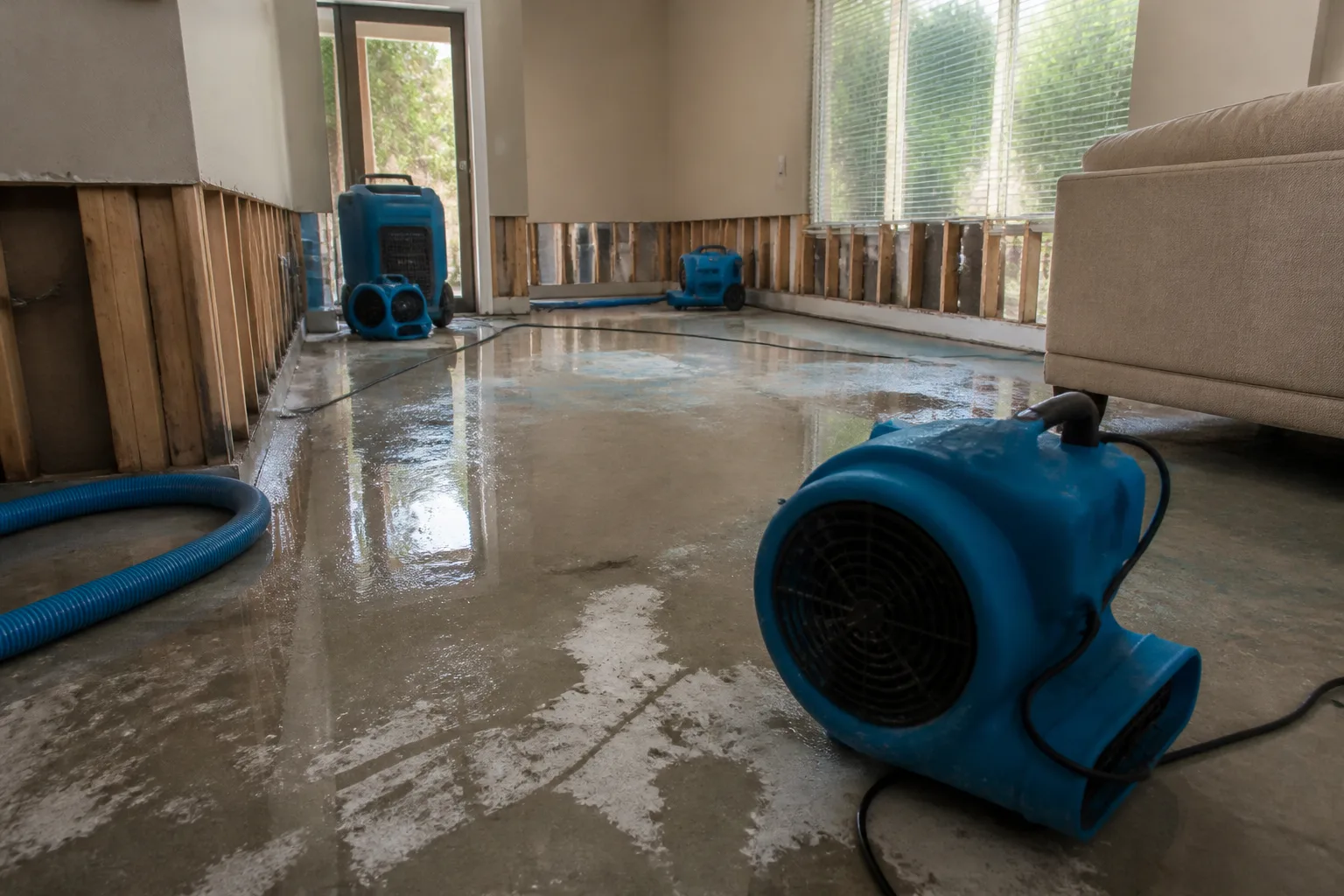
Water Damage Restoration What It Really Costs: What Rialto Homeowners Pay in 2026
Most Rialto homes we walk into after a water event fall into a repair range of $2,800 to $9,600, with sewage-related damage pushing well past $14,000. The spread isn’t because contractors are guessing. It’s because two jobs that look identical from the hallway can require completely different scopes of work: one needs drying, the other needs demolition, disposal, and rebuild. If you’re staring at two quotes that are $7,000 apart, this post explains exactly what’s behind that gap, so you can read your estimate like an adjuster would. If you’d rather not sort through the line items yourself, call (866) 472-6137 and we’ll walk the job with you.
We’re writing this because Rialto homeowners keep getting handed national cost averages that have nothing to do with what restoration actually costs in San Bernardino County. A house off Riverside Avenue built in 1978 has different materials behind its drywall than a new build in the Las Colinas area. Different materials, different drying times, different prices. Here’s the real framework.
What Most “Average Cost” Articles Get Wrong About Rialto
That $3,500 “national average” you keep seeing for water damage restoration? It’s built from claims data pulled from every market in the country, including states with no contractor licensing requirements and labor costs 40% below California’s. When you apply that number to Rialto, you’re pricing a job with the wrong cost basis.
Here’s what actually moves the number in Rialto specifically:
- California contractor licensing: restoration work that touches electrical or plumbing subsystems requires licensed subcontractors. A water heater flood that soaked through the subfloor into a wall cavity near your panel? That’s a plumber and an electrician on the invoice. You’re not paying for “fancy service.” You’re paying for code-compliant work.
- San Bernardino County permit fees: any restoration involving structural drying verification or rebuild over a certain dollar threshold triggers a permit. Those fees run differently here than in Orange County.
- Rialto housing stock: a large share of Rialto homes were built between the 1960s and 1990s. That means plaster and lath in some walls, vinyl sheet flooring over particleboard subfloor in some kitchens, and copper supply lines that fail catastrophically in specific ways. Each of these materials responds differently to saturation.
- Distance from drying-equipment suppliers: this is small but real. Independent restoration firms in Rialto pay freight and time costs to keep Dri-Eaz and Injectidry stock moving. National franchises amortize that across hundreds of branches. Local independents either absorb it or price it honestly.
Our Trailblazer Water Damage home page covers more on how we scope Rialto jobs from the first inspection.
The Real Cost Framework: Class and Category Matter More Than Square Footage
When we price a water damage job, we start with two classification questions. Not “how big is the wet spot.” The questions are: what class is the saturation, and what category is the water. These two answers drive more cost than any other single factor.
Water Classes: How Deep the Water Goes
- Class 1: minimal absorption. Water touched a low-porosity surface, dried fast. A supply line leak caught within hours on tile. $1,200 to $2,800 range in Rialto.
- Class 2: full room saturation into carpet, padding, and up drywall wicking. We see this most often in Rialto homes where a water heater in the garage let go overnight. $3,600 to $7,500.
- Class 3: water came from above and saturated walls, insulation, and ceilings. Ceiling collapse risk, multiple rooms. $7,800 to $14,000+.
- Class 4: deep saturation into low-evaporation materials: hardwood, stone, concrete, plaster. Requires specialty drying systems like Injectidry cavity drying. This is where costs climb fastest because the drying is slow by design.
Water Categories: What’s Actually in the Water
- Category 1 (clean): supply line, tub overflow, sink. Water is potable or nearly potable. Drying in place is often viable.
- Category 2 (gray): dishwasher discharge, washing machine overflow, sump pump failure. Contains biological or chemical contaminants. Requires carpet replacement, pad disposal, and antimicrobial treatment.
- Category 3 (black): sewage, floodwater, toilet backflow. Every porous material it touches gets cut out and disposed of. Drywall, baseboard, carpet, pad, insulation, sometimes cabinet boxes. Full PPE for crews. Biohazard disposal protocols.
Here’s the part most homeowners don’t hear: Category 3 costs 2 to 3 times more than Category 1 for the exact same square footage. Not because anyone’s padding the bill. Because you’re not drying anything. You’re removing and rebuilding. A 300-square-foot bathroom with Category 1 water from a failed toilet supply line might cost $2,900 to dry. The same bathroom with Category 3 sewage backflow is $8,000 to $11,000 because the bottom three feet of drywall, the vanity, the flooring, and the subfloor in the affected area all go to the dump. Then the rebuild starts at framing.
If you’re dealing with water damage in Rialto right now, our Water Damage Restoration in Rialto page explains our scoping process in detail.
What Xactimate Pricing Covers, and What Rialto Contractors Legitimately Add
Xactimate is the software most insurance carriers and restoration firms use to estimate property damage costs. It’s built on regional pricing data, and it’s a decent benchmark. But it’s also the source of most billing-argument confusion.
Here’s what Xactimate line items cover: materials at regional average cost, labor at surveyed local rates, standard equipment rental rates, and basic disposal fees. What Xactimate often does not adequately cover in the Rialto market:
- Regional cost modifiers: California contractors can apply for and receive regional pricing factors in Xactimate that adjust for our higher workers’ comp rates, fuel costs, and supplier pricing. Legitimate companies list these modifiers on the estimate. If a bid is 15 to 25 percent above raw Xactimate, that’s often the modifier, not markup.
- Specialty drying equipment: Xactimate prices standard air movers and dehumidifiers. Injectidry cavity-drying systems cost more per day to operate and are priced as specialty equipment on a separate line. If your water migrated into wall cavities, that line is legitimate, not padding.
- Testing and verification: moisture mapping, thermal imaging documentation, and final dry-standard verification. Adjusters rarely argue these if they’re itemized and properly documented. Most homeowner complaint stories we hear in Rialto come from estimates where these lines were bundled vaguely, so the homeowner couldn’t tell what they paid for.
- After-hours labor: a Friday-night water heater failure in a Rialto neighborhood doesn’t care about standard labor pricing. Emergency response costs more. A legitimate company shows you that as a separate labor rate on the estimate.
When you’re reading your estimate and something says “supplement” or “vendor adjustment,” that’s not automatically a red flag. Ask what it covers. A real restoration firm will tell you in plain English. If they get defensive, that’s your signal to get a second opinion.
We pulled a water heater out of a garage near Foothill Boulevard a few months back where the homeowner had three quotes. Two of them had zero equipment line items. Just a lump sum for “drying.” One of those quotes was $2,100. The third had eleven equipment lines, two Injectidry system days, and a moisture map with weekly readings. That one was $9,800. The cheap one would have left damp wall cavities behind the garage drywall. Six to nine months later, that’s mold. Call us at (866) 472-6137 and we’ll show you the difference on your own estimate.
The True Cost of Waiting: What 48 Hours Does to a Rialto Home
Here’s a scenario we see every month in Rialto: a toilet supply line fails on a Thursday morning. Homeowner shuts off the water at the angle stop, mops up the visible water, sets up a box fan, and waits through the weekend because “it’s mostly dry.” By Monday, the baseboard is swelling at the seams, the drywall has a tide line about fourteen inches up, and the linoleum in the adjacent hallway is lifting at the edges.
What happened in those 48 to 72 hours is called class escalation. Water that stays in contact with building materials wicks upward and outward. The job on Thursday was a Class 1: wet tile, little absorption, $1,800 to $2,500, no demolition. The job on Monday is a Class 2 or Class 3: saturated drywall wicking up from the baseplate, water trapped between the vinyl floor and the particleboard subfloor, and humidity spreading into the wall cavities. That’s now a $6,000 to $9,000 job with trim removal, carpet and pad disposal, drywall cuts, and running drying equipment for five to seven days.
For a typical Rialto tract home in the 1,400 to 1,800 square foot range, every day of delay between the water event and professional extraction adds roughly $900 to $1,400 to the final bill. Not because anyone’s gouging. Because the scope grows. Materials that could have been dried in place reach saturation thresholds and get replaced instead.
And that’s the cheap half of the problem. The expensive half is what grows in the dark after the surfaces dry. A wall cavity that stays warm and damp for 72 hours is biologically active. You can’t see it from the living room. Six months later, when the musty smell starts, the water restoration job has become a Mold Remediation in Rialto job, and mold remediation runs $2,500 to $6,000 or more depending on containment and air-quality protocols.
The fastest way to keep a small water problem small in Rialto is to get extraction started the same day. Not mopping. Extraction. The difference isn’t effort level. It’s what’s happening inside the wall behind the baseboard.
Related: Fire Damage Restoration in Rialto involves many of the same water-damage complications from firefighting water, and we handle both in-house.
What Your California Homeowners Policy Actually Pays in 2026
We’re going to speak plainly here because this is where Rialto homeowners get hurt. Most standard HO-3 policies in California cover sudden and accidental water damage from interior sources: a burst supply line, a failed water heater, an overflowed tub. If water comes from inside your home suddenly and you didn’t cause it through negligence, you’re generally covered for extraction, drying, and repairs up to your policy limits, minus your deductible.
What most policies in 2026 increasingly do not cover, or cover with significant restrictions:
- Groundwater and flood damage: excluded unless you have a separate FEMA or private flood policy. Rialto sits in a flood plain in parts. A heavy storm that sends water under your door is floodwater under most policies, and your standard homeowners insurance doesn’t cover it.
- Slow leaks and seepage: if water has been leaking for weeks or months, carriers increasingly deny coverage citing “maintenance failure” or “long-term seepage” exclusions. The logic is that the homeowner should have caught it earlier. We see this denial most often on supply line pinhole leaks inside walls.
- Mold remediation beyond a sub-limit: many California policies carry a $5,000 mold sub-limit, some as low as $2,500, and some with none at all unless it’s a covered water event. If mold develops from a covered loss, remediation may be partially covered. If mold is “pre-existing” or from humidity, it’s usually on you.
- Secondary damages: if you waited too long and the damage spread, some adjusters will argue the additional scope is a failure-to-mitigate issue. Your policy requires you to take reasonable steps to stop further damage. What “reasonable” means varies, and adjusters have discretion.
The coverage gap that hits Rialto homeowners hardest is the space between what the carrier approves and what the home actually needs to be dry and safe. An adjuster approves extraction and four days of drying. The reality is eight days of drying plus cavity treatment and baseboard replacement. That gap can run $1,500 to $4,000 out of pocket. A restoration firm that understands insurance documentation can often close that gap with proper moisture mapping and daily logs that justify supplements. We’re not adjusters, and we can’t tell you what your policy covers. But we document every reading, every equipment placement, every dry-standard measurement, with before and after photos and written scopes. That documentation is what turns a denied claim into an approved supplement. Our Water Damage Restoration in Rialto team handles adjuster coordination as a standard part of the job, not an add-on.
Why Two Quotes for the Same Flooded Bathroom Are $7,000 Apart
Back to the opening question. You got a quote for $4,200 and another for $11,800 for the same bathroom. What’s actually happening?
The $4,200 quote is almost certainly scoped as a Category 1, Class 2 job: extract standing water, pull the carpet in the adjacent bedroom, set air movers and a dehumidifier for five days, replace the baseboard, repaint the seam, done. If the water was clean and caught early, and there’s no wicking beyond the vanity wall, that quote might be completely legitimate.
The $11,800 quote is scoped as something else: Category 2 water that requires carpet and pad replacement, drywall cut 18 to 24 inches up with removal and disposal, antimicrobial treatment on the framing, vanity removal and reset, flooring replacement in the adjacent room due to water traveling under the walls, and a rebuild scope that includes texture matching and paint. That’s also legitimate. It’s the same bathroom. It’s not the same job.
The danger is the $4,200 contractor who does the $11,800 scope’s half-measure. You pay $4,200, the bathroom looks fine for nine months, and then you smell it. That contractor is gone, and you now have a $6,000 mold problem that insurance won’t touch because the source was a “prior loss.”
The $11,800 contractor who does the $4,200 scope is also a problem. You’re overpaying for demolition that didn’t need to happen. The way you tell the difference in Rialto is moisture mapping. A legitimate restoration firm hands you a moisture map showing saturation readings in each affected room, the drying plan based on class and category, and a written scope that says what gets dried in place versus what gets removed. We produce that document on every single job. No verbal handshake. When we say “we dry it right the first time,” we mean the moisture map in your hand before the first air mover gets plugged in.
If you’re in the middle of this right now and need someone to look at the water before the weekend, call (866) 472-6137. Estimates are free, and we’ll tell you straight what the scope really is. Even if you hire someone else, you’ll know what to look for.
The Bottom Line
Rialto water damage restoration in 2026 runs roughly $2,800 to $9,600 for most residential events, with sewage or extensive Category 3 damage exceeding $14,000. The number is driven by water class and category, not just square footage. Waiting more than 48 hours reliably escalates a manageable drying job into a demolition and rebuild, and the cost difference lands on you if your policy excludes secondary damage. When you compare quotes in Rialto, compare scopes, not totals. A moisture map and a written dry-standard plan are the difference between a $4,200 job that’s done right and a $4,200 job that becomes next year’s mold problem.
If you’re in Rialto and need help, Trailblazer Water Damage offers free estimates. We’re an IICRC-certified team running Dri-Eaz, Phoenix, and Injectidry equipment. We’ll scope your job, document everything for your adjuster, and tell you what actually needs to happen. Call (866) 472-6137.
Frequently Asked Questions
Most Rialto residential water damage jobs fall between $2,800 and $9,600, with sewage-related or Category 3 damage exceeding $14,000. Your specific cost depends on the water class (how deep the saturation goes), the water category (what’s in the water), and how long it’s been sitting. Call (866) 472-6137 for a free estimate on your specific situation.
Most standard HO-3 policies in California cover sudden and accidental interior water damage like burst supply lines and water heater failures. Coverage typically excludes floodwater, slow leaks, and pre-existing mold unless specific riders apply. Your best path is to document everything from day one and work with a restoration firm that produces insurance-grade documentation. We handle adjuster coordination on every Rialto job.
We dispatch to Rialto water damage calls the same day you call (866) 472-6137. The clock matters because water class escalates within 48 to 72 hours, turning a $2,500 drying job into an $8,000 demolition and rebuild. Same-day extraction is the single biggest cost-control move you can make.
If the water is Category 1 (clean supply line) and you caught it within hours, professional extraction and drying may be all you need, with no material removal beyond what’s saturated beyond dry standard. If the water is Category 2 or 3, or if it sat for more than two days, you need actual remediation: material removal, antimicrobial treatment, and cavity drying. A moisture map tells you which situation you have. We produce one on every inspection, free.
We do. Our team provides photo documentation, daily moisture logs, equipment placement records, and dry-standard verification in the format adjusters expect. We can’t tell you what your policy covers or override a carrier’s decision, but we can give your adjuster the documentation that justifies every line item on the scope. That’s what we mean by “built for insurance-level documentation.”
Written by the team at Trailblazer Water Damage, serving Rialto since 2013.
Need Damage Restoration Help?
Call Trailblazer Water Damage — licensed & insured, here with fast after-hours help in Rialto.
(866) 472-6137