IICRC Water Damage Restoration in Rialto: A Homeowner’s Guide
IICRC water damage restoration in Rialto means hiring a company whose technicians hold certifications from the Institute of Inspection, Cleaning and Restoration Certification, the body that writes the S500 standard your insurance policy almost certainly references. If the crew standing in your flooded living room can’t produce current IICRC credentials, you’re gambling with both your claim and your family’s health. Here’s what every Rialto homeowner needs to know before water soaks through the slab.
If you’d rather skip the research and get someone credentialed on site now, call (866) 472-6137 for a free estimate.
IICRC Firm Certification vs. Technician Certification: Why You Need Both
Here’s the distinction most homeowners miss: IICRC certifies both companies and individuals, and they mean different things. A firm certification means the company has met the IICRC’s operational requirements for insurance, documentation, and business practices. A technician certification means a specific person passed the exam for a specific skill. When a restoration company in Rialto says “we’re IICRC certified,” you should ask a follow-up: “Which technicians hold which credentials, and are they current?”
We’ve walked into homes where a company’s only IICRC credential belonged to an owner who hadn’t set foot on a job in years. The crew doing the actual extraction and drying held nothing. In Rialto, where slab foundations and older stucco construction create distinct drying challenges, the credential on the truck door doesn’t dry your Sheetrock. The person holding the moisture meter does.
Verify both levels. Ask for the technician’s name, then check it against the IICRC’s public directory while they’re standing there. A legitimate firm won’t flinch at this request. One that gets defensive is telling you something useful.
What WRT and ASD Actually Authorize a Technician to Do
Two credentials matter most in water damage restoration: WRT (Water Restoration Technician) and ASD (Applied Structural Drying). WRT covers the fundamentals of extraction, containment, and antimicrobial application. It’s the entry credential, and it’s what a technician needs to competently pull water from carpet, pad, and hard surfaces in a Rialto living room after a supply line burst.
ASD goes further. It authorizes a technician to calculate drying chamber requirements, place air movers and dehumidifiers using psychrometric data, and monitor drying progress against a target. An ASD-certified technician knows how to dry wall cavities and subfloor structures without unnecessary tear-out. That’s the credential that determines whether your home dries in four days or four weeks, and whether you lose the bottom 24 inches of drywall.
What neither credential authorizes: electrical work, structural repair beyond drying scope, or plumbing repairs. If water has compromised wiring or fixtures, you still need a licensed electrician. An honest restoration company will tell you where their scope ends. That’s how we operate in Rialto and everywhere else we work.
How IICRC S500 Classes Map to Real Damage in Rialto Homes
The IICRC S500 standard classifies water damage into four classes based on evaporation load and material absorption. These aren’t abstract categories. They map directly to what we see in Rialto’s housing stock.
Class 1 affects a small area with low-porosity materials like concrete or tile. Picture a water heater leaking onto a concrete garage floor. Limited drying equipment, shorter timeline. Class 2 involves a larger area with moderately porous materials like carpet and pad. A second-floor bathroom overflow onto hallway carpet falls here. Class 3 is the biggest concern: water saturated walls, ceilings, insulation, and subfloor. This is the saturated stucco-wall scenario Rialto homeowners know too well after a roof leak goes unnoticed for a week. Class 3 requires aggressive drying and often some demolition. Class 4 means water trapped in materials with low permeance, like hardwood, brick, or plaster. In Rialto’s older homes with lath-and-plaster walls, Class 4 drying almost always requires specialty systems.
Slab foundations add another variable. Water can travel under flooring and wick up through concrete, creating hidden moisture that standard drying equipment can’t reach without the right plan. A technician who understands how moisture behaves under a Rialto slab is worth more than a technician who only knows how to set up an air mover.
Why the Paper Trail Protects You at Claim Time
An IICRC-certified company should produce documentation that would satisfy an insurance adjuster without a fight. This is where the credential translates into dollars. Here’s what the paper trail should include:
- Moisture logs: Daily readings from affected materials showing moisture content trending downward. Starting numbers, daily intervals, target dry standard.
- Psychrometric readings: Temperature and relative humidity inside the drying chamber, matched against outside conditions, used to calculate grain depression and verify dehumidifier performance.
- Equipment placement records: Where each Dri-Eaz air mover, Phoenix dehumidifier, and Injectidry panel was placed, when it was installed, and when it was moved or removed.
- Scope documentation: Photos of affected areas before work starts, during drying, and after completion. Dates, times, and technician names attached to each entry.
Adjusters in Rialto see claims from every imaginable source. Adjusters respect documentation that reads like it was built by someone credentialed. Adjusters deny claims that read like a guess with a wet-vac attached. If your restoration company hands you a handwritten note and a vague promise, you’re exposed. With an IICRC-certified team, the documentation is built for insurance-level scrutiny.
How to Verify a Company’s IICRC Status in Real Time
Verification takes less than five minutes and it’s the single most useful thing a Rialto homeowner can do before signing anything. Here’s the process:
- Go to the IICRC’s official public directory at iicrc.org and select the locator tool.
- Search by company name and location. If the company claims IICRC firm certification, it appears here.
- Ask the technician on site for their personal IICRC certification number. This is a six-digit number tied to that individual.
- Enter that number into the directory’s technician verification field. It will show the credential type (WRT, ASD, etc.) and current status.
- If the company or technician doesn’t appear, or the credential shows as expired, stop the work and ask questions.
Lapsed credentials happen. Technicians forget to renew when work is busy. But a lapsed credential means that person’s training verification is no longer current. That’s a risk you don’t need to accept in the middle of a water event. We pulled one out of a garage over in the Las Colinas area a few months back where the homeowner had hired another company before calling us. The “certified” tech turned out to hold an expired ASD credential from 2019. The drying was already five days in, and the wall cavity moisture readings hadn’t moved. It’s not unusual, and that’s the problem.
Why Equipment Matters as Much as Credentials
Credentials tell you a technician knows how to dry. Equipment determines whether they can actually do it. The two work together. A tech with an ASD cert and a rental-grade dehumidifier from a big-box store is working with one hand tied behind their back.
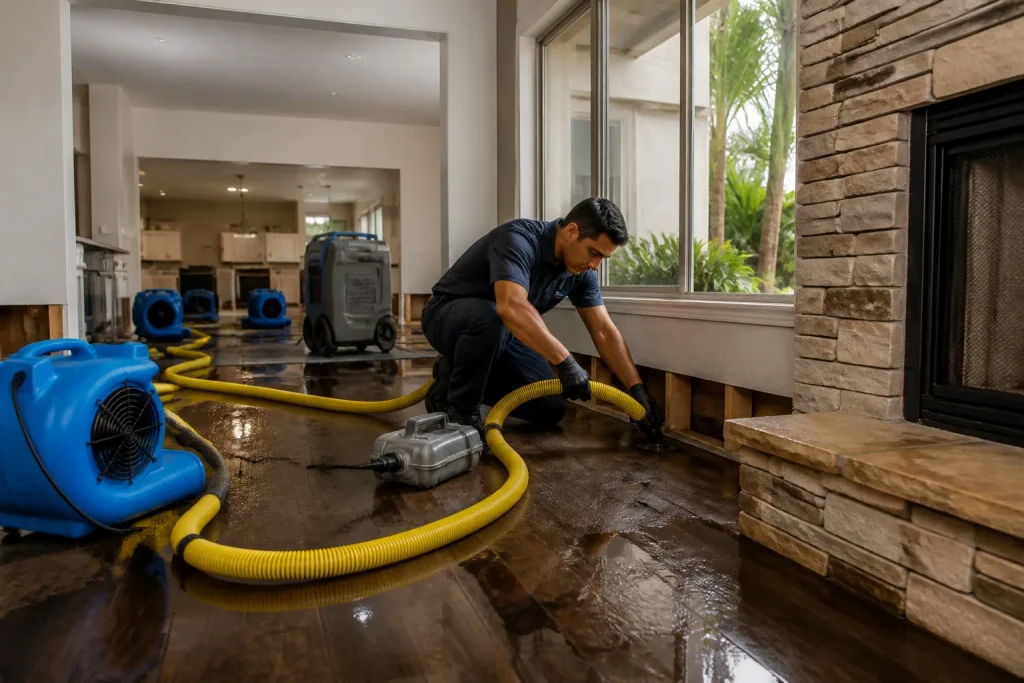
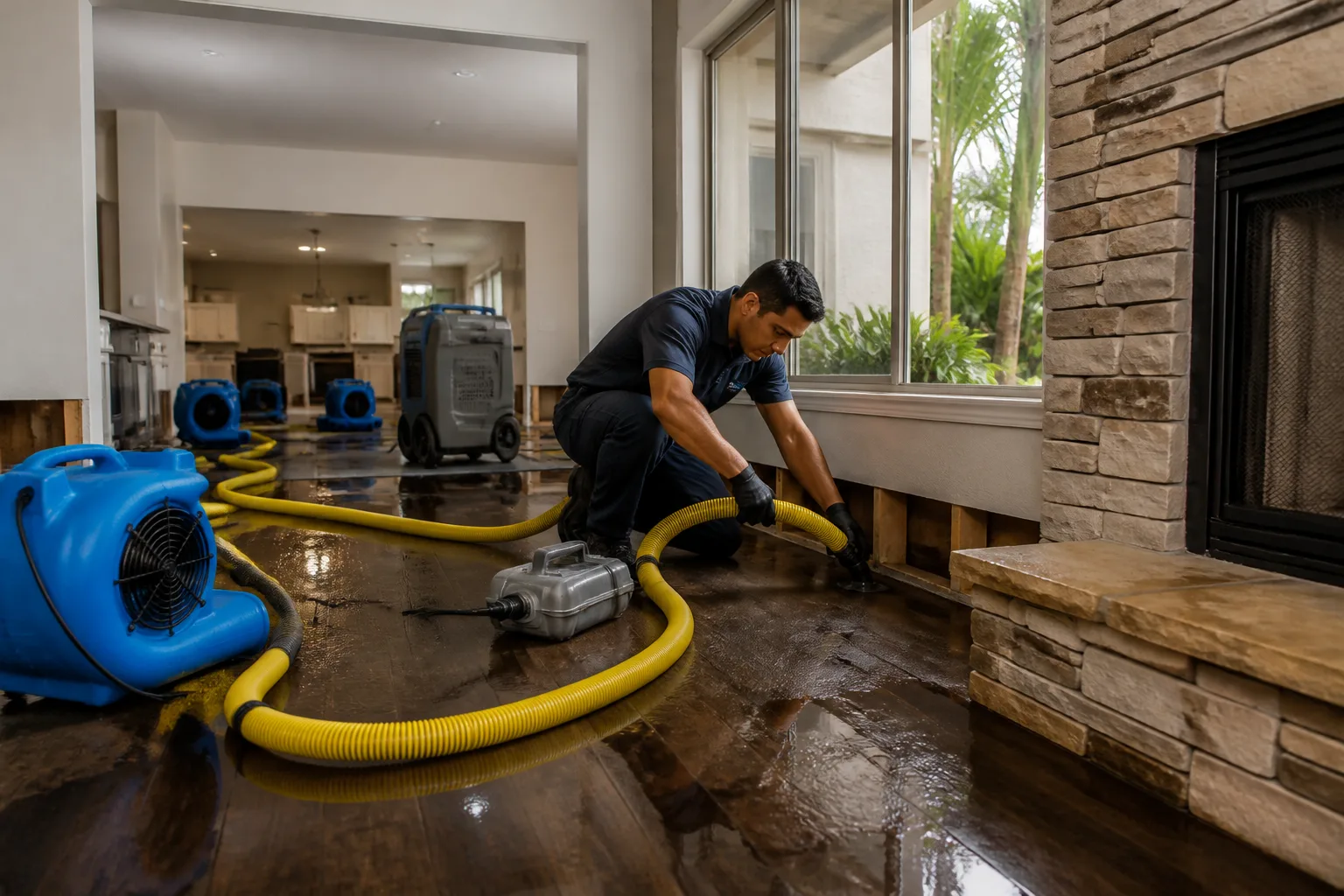
Professional restoration relies on professional-grade systems. Dri-Eaz dehumidifiers move hundreds of pints of water per day. Phoenix air movers create the airflow needed to push moisture out of materials. Injectidry panels pull water from wall cavities and under cabinets without tearing out drywall. These are the same brands national franchises run. They’ve earned their reputation through thousands of drying projects, including plenty in Rialto where slab moisture migration makes drying harder than it looks.
Equipment brands aren’t a marketing point. They’re a functional requirement. A homeowner who knows the difference between a box fan and a Phoenix air mover is a homeowner who can’t be oversold. When a company brings real equipment to a Rialto flood, you’ll see it in the moisture logs and in the drying timeline.
When to Call a Pro
Water damage in Rialto moves fast. Category 2 water from a washing machine overflow sits for 48 hours and becomes a Category 3 situation with bacterial growth. If water has touched drywall, traveled under flooring, or sat for more than 24 hours, professional extraction and drying isn’t optional. It’s the difference between a week-long drying project and a month of mold remediation.
Also call a pro immediately if you can smell anything musty, if paint is bubbling, or if baseboards are warping. These are signs water has moved into places you can’t see. The cavity inside a Rialto exterior wall, with stucco on the outside and drywall inside, is a perfect environment for hidden moisture. We dry it right the first time, because the second time always costs more.
Related Services in Rialto
Water damage doesn’t stay water damage for long. If drying takes too long or the water sat too long, Mold Remediation in Rialto becomes the next call. If the water came from a fire suppression system or a fire itself, Fire Damage Restoration in Rialto handles the combined effects of soot, smoke, and water. And for the full sequence of damage, from extraction to clearance, our Water Damage Restoration in Rialto page walks through what a complete job looks like. You can also start at the Trailblazer Water Damage home page for an overview of everything we do.
What happens when you call
- 1
A real person answersNo phone trees — you reach a local pro.
- 2
You get an upfront price rangeHonest numbers before anyone is dispatched.
- 3
A background-checked tech heads outLicensed & insured, dispatched right away.
- 4
You approve before work beginsNothing starts until you say go.
The Bottom Line
IICRC certification isn’t a wall decoration. It’s the standard your insurance policy references, the training your technicians either have or don’t, and the difference between a drying log an adjuster accepts and one they reject. In Rialto specifically, where slab foundations and older construction create drying challenges you won’t find in newer housing stock, that credential gap shows up in delayed drying, hidden mold, and denied claims.
Verify the company. Verify the technician. Ask for the documentation before the equipment comes off the truck. If you’re in Rialto and need help now, Trailblazer Water Damage offers free estimates. Call (866) 472-6137 and we’ll walk you through what we’re seeing and what it takes to fix it.
Frequently Asked Questions
IICRC stands for the Institute of Inspection, Cleaning and Restoration Certification. It’s the nonprofit body that establishes the S500 Standard for professional water damage restoration and certifies both restoration firms and individual technicians who pass its examinations.
Check the IICRC’s public directory online. Enter the company name to verify firm certification, then ask the technician on site for their personal six-digit certification number and verify it the same way. If either check comes back empty or expired, do not proceed with the work.
WRT (Water Restoration Technician) covers foundational extraction and drying procedures. ASD (Applied Structural Drying) is an advanced credential that authorizes a technician to design and monitor a complete structural drying plan, including psychrometric calculations and cavity drying. Both matter, but ASD is the credential you want overseeing a major dry-out.
Most residential insurance policies reference the IICRC S500 standard as the benchmark for professional water damage restoration. While a policy may not explicitly name IICRC in every case, adjusters evaluate work against the standard. Hiring a non-certified company risks work that falls short of what your policy expects, which can complicate or reduce your claim payout. Call (866) 472-6137 for guidance on documentation before you file.
Written by the team at Trailblazer Water Damage, serving Rialto since 2013.
Need Damage Restoration Help?
Call Trailblazer Water Damage — licensed & insured, here with fast after-hours help in Rialto.
(866) 472-6137