Emergency Water Damage Restoration Near Me: What Rialto Homeowners Should Do First
If water is spreading through your Rialto home right now, the first thirty minutes decide how much of this is a cleanup and how much becomes a rebuild. Shut off the water source if you can reach it safely, kill power to affected areas at the breaker, and document everything with your phone before moving anything. Then call Trailblazer Water Damage home at (866) 472-6137 so a certified crew can establish a real moisture baseline before secondary damage sets in. If you’d rather handle the first steps yourself before making that call, the protocol below walks you through it in order.
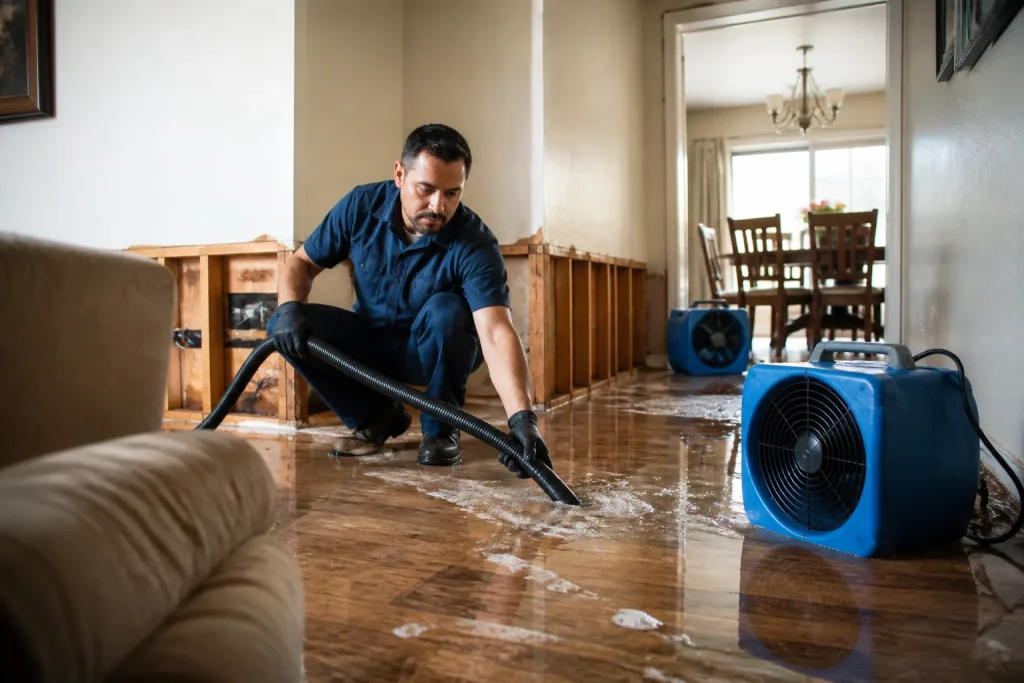
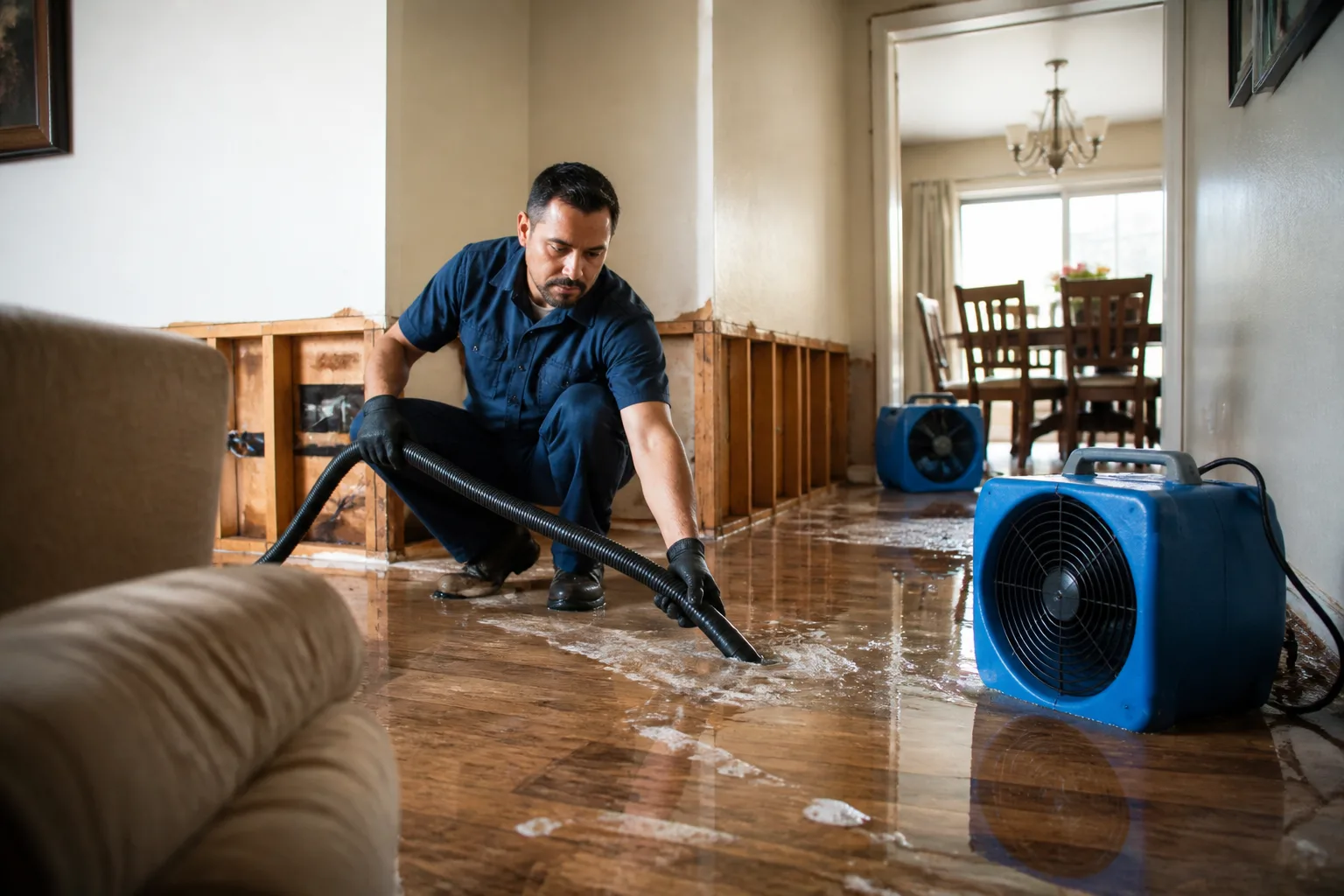
The mistake we see over and over in Rialto is homeowners grabbing a shop vac before doing anything else. It feels like the right move. It’s usually the wrong one. If that water came from a sewage backup, a roof breach during one of our storm events, or a supply line that’s been soaking drywall for hours, you’ve just aerosolized contaminated water and destroyed the evidence an adjuster needs to approve your claim.
The First Ten Minutes: Shut Down, Document, Then Touch Nothing
The sequence matters more than the speed. None of these steps are complicated, but doing them out of order is where claims get denied and structures get compromised.
- Kill power to the affected floor at the breaker. Only if the panel is dry and you can reach it without walking through standing water. If the panel is wet or you have any doubt, call Rialto’s utility department and have them cut it at the meter. Water and live outlets are a lethal combination, and electricity travels through wet drywall even when the visible puddle is across the room.
- Identify the source. If it’s a clean supply line you can reach, shut the valve. If it’s sewage, a roof leak, or water that’s been sitting more than 24 hours, do not wade in. That’s Category 3 territory and the water itself is now a health hazard.
- Photograph everything before you move a single piece of furniture. Wide shots of every affected room, close-ups of water lines on baseboards, shots of the source if visible, and the underside of any sagging drywall. These photos are your mitigation-duty record. Insurance expects you to act reasonably to prevent further damage, and you can’t prove you did that without a visual baseline.
- Call a restoration company that can be on-site within hours, not days. Every hour of standing water in Rialto’s climate accelerates mold growth and wicks moisture up drywall, through subfloor, and into wall cavities as far as two to three feet above the visible water line.
What you should not do: run fans from Home Depot, set a space heater on the floor, open windows if the outside humidity is above 50 percent, or start pulling wet carpet yourself. Each of these actions either spreads contamination, masks the moisture signature we need for proper drying, or voids the restraint your policy expects you to show during the mitigation phase.
What Rialto’s Infrastructure Means for Your Emergency
Rialto’s water profile creates risk scenarios that don’t show up in generic restoration guides. The neighborhoods east of Cedar Avenue, stretching toward the Agua Mansa industrial corridor, sit on a mix of vintage water mains that predate current seismic standards. We’ve responded to supply-line failures in those blocks where the water ran clean for the first hour and picked up sediment and pipe scale after that, because the break had pulled contaminants backward through the system.
That changes how we classify the water. Not all clear water is Category 1. If you’re near Agua Mansa or in an older section of east Rialto where the mains date back decades, let the restoration team sample and classify before anyone starts extracting. The same applies to any intrusion from storm runoff. Rialto’s flat grades and the way water channels along Foothill Boulevard during heavy rain means your flooded garage might not be holding rainwater. It might be carrying whatever washed off commercial properties upstream.
This is where Water Damage Restoration in Rialto done by a team that knows these specific blocks matters. A national franchise dispatch team doesn’t know that a home near the old rail spurs has different contamination risk than one up in the Las Colinas development. We do, because we’ve pulled standing water out of both.
How to Talk to Your Insurance Company in the First Call
Most homeowners hurt their own claims within three minutes of getting the adjuster on the phone. Not by lying. By using the wrong words. The first call to your carrier is recorded and becomes part of the claim file. What you say here sets the tone for everything that follows.
Say this:
- “Water entered the home on [date]. I shut off the source at [location] and killed power to the affected area at the breaker.”
- “I’ve taken photos of every affected room before moving anything. I’ve also called a mitigation company to prevent further damage.”
- “I understand I have a duty to mitigate, and I’m acting on that now.”
Do not say this:
- “I think it’s been leaking for a while.” That’s an admission of lack of maintenance, which some policies exclude.
- “It’s not that bad.” You don’t know that yet. Hidden moisture in walls and under flooring is where the real repair cost lives, and you can’t see it without a FLIR camera and moisture meter.
- “I already started ripping out the carpet.” Unilateral tear-out before the adjuster documents damage can put you in a dispute over scope.
The phrase “mitigation duty” is the unlock. Your policy requires you to act reasonably to prevent additional damage. When you use that language, you’re telling the adjuster you understand the contract and you’re holding up your end. Restoration comes with built-in documentation, which your adjuster needs and which we generate as a standard part of every job.
What a Legitimate Emergency Response Actually Looks Like
By the time we leave your house on day one, the setup should look nothing like a cleanup crew from a general contractor. The equipment matters because drying science is physics, not elbow grease. Here’s what professional-grade means in practice, and what to look for when you’re comparing companies on an emergency call.
A real emergency extraction setup runs on truck-mounted extractors, not the portable carpet-cleaning units you rent from a grocery store. A truck mount pulls 300 to 500 pounds of water out of carpet and pad in the time a portable unit pulls 50. That difference is measured in days of drying, which is measured in mold risk, which is measured in how much of your house has to be rebuilt.
Within the first visit, a legitimate crew is also running:
- FLIR thermal imaging on every wall, ceiling, and floor surface in the affected area and one room beyond it. This finds hidden moisture in wall cavities before it destroys insulation and framing.
- Moisture meter readings against a dry baseline from an unaffected room, so we know what we’re chasing and when we’re done.
- Commercial LGR dehumidifiers staged and running before the crew leaves, not promised for tomorrow. LGR stands for low grain refrigerant, and these pull water vapor out of the air far below the range of consumer dehumidifiers.
- Injectidry cavity-drying systems where walls are wet but intact. This is the difference between drying inside a wall through small access points and ripping out drywall that could have been saved. We’ve used it in dozens of Rialto homes to keep kitchens and finished garages intact that a tear-out crew would have gutted.
Our equipment stack runs Dri-Eaz, Phoenix, and B-Air on the air-moving side, and an IICRC-certified team runs the extraction and drying plan. We’ve been asked more than once why a local independent runs the same gear as the big franchises. The answer is simple: the equipment is what the science demands, and the science doesn’t care how big your company is. It cares whether you do it right the first time.
When to Evacuate vs. When to Stay
Most water damage does not require you to leave your home. But the threshold for evacuation is not about how inconvenienced you are. It’s about what’s in the water and what’s happening to the structure.
Evacuate if:
- The water source is sewage or a backed-up drain line. Category 3 water carries pathogens that become airborne during extraction and drying. This is not a smell problem. It’s a biohazard.
- Water has been standing more than 48 hours. Mold colonization starts within 24 to 48 hours on porous surfaces, and once it’s established in the air column, sensitive occupants will react before you see visible growth.
- Ceilings are visibly sagging or drywall is bowing outward. That’s trapped water adding weight. When the sheetrock lets go, it comes down in chunks that have hurt people.
- Anyone in the home is immunocompromised, elderly, or under two years old. These groups do not bounce back from mold exposure the way a healthy adult does.
You can likely stay if:
- The intrusion is clean water from a supply line that was caught within hours.
- The affected area is isolated to one room with tile or concrete flooring.
- You have containment set up and LGR dehumidifiers running, and the affected rooms are closed off from living spaces.
- A certified restoration team has assessed the site and confirmed no hidden moisture in wall cavities.
The authority to make that evacuation call sits with whoever has measured the moisture and classified the water. An IICRC-certified team carries that authority because the certification exists precisely to standardize these judgments. If a company shows up with no certification and a confident opinion, that’s not expertise. That’s a guess wearing a uniform.
The Minute-by-Minute Protocol
Here is the full sequence, in order, for the first hour after you discover water damage in your Rialto home.
- Minutes 0 to 5: Kill power to the affected area at the breaker, if safe. Shut the water source if accessible without entering standing water.
- Minutes 5 to 15: Photograph everything. Every room, every wall, the source if visible, the water line on baseboards and furniture. Before anything is moved.
- Minutes 15 to 20: Call your insurance carrier. Use the mitigation-duty language. Get a claim number. Ask if they have a list of preferred providers, and know that you are not required to use them. You have the right to choose your own restoration company.
- Minutes 20 to 30: Call a certified restoration team. Get someone on-site who can establish a proper moisture baseline and start extraction with professional equipment. If the call goes to voicemail, call the next company. This is not a moment to leave a message and wait.
- After hour one: Keep the affected area sealed off from living space. Don’t run your HVAC system if the water event is in or near the return air path. Wait for the professionals to arrive with the right gear.
One note from the field. A homeowner over in the neighborhood just north of the 210 near Linden Avenue called us last winter after a water heater failed while he was at work. He’d been home for twenty minutes and already had a shop vac running. The problem: the water had been sitting on laminate for nine hours, and that laminate was now hiding a half-inch of water underneath it. The portable vac was pulling surface water while the underlayment kept wicking. By the time we got there, the moisture had traveled eight feet into the kitchen. That job ended up being a full floor replacement. If he’d called first, we could have dried the subfloor in place. The lesson: the first tool you reach for matters less than the first call you make.
When to Call a Pro
You should call a professional restoration company immediately if the water covers more than one room, came from anything other than a clean supply line, has been sitting more than a few hours, or touched drywall. Drywall and insulation wick moisture aggressively, and once water is inside a wall cavity, you are no longer dealing with a drying project. You’re dealing with a moisture-removal project that requires equipment, metering, and documentation your insurance company will scrutinize.
If you’re in Rialto and dealing with water damage, our team at Trailblazer can respond with truck-mounted extraction, FLIR imaging, and LGR dehumidifiers on day one. Related services in Rialto include Mold Remediation in Rialto for any secondary growth that emerges after water intrusion, and Fire Damage Restoration in Rialto for homes dealing with the aftermath of a fire event where water damage from suppression systems is part of the picture.
The Bottom Line
The first thirty minutes after water damage are your highest-leverage window. Kill power, shut the source, photograph everything, call insurance with the right language, and get a certified team on-site before you spend energy on cleanup. Moving water around without a moisture baseline destroys evidence, spreads contamination, and often makes the repair bigger than it needed to be. Rialto’s infrastructure, from older mains in east Rialto to stormwater patterns near Agua Mansa, adds local risk factors that a generic crew won’t know to look for. If you’re in Rialto and need help, call us at (866) 472-6137 for a free estimate. We’ll walk you through the first steps on the phone, then get a crew to your door.
Frequently Asked Questions
Call within the first thirty minutes if possible. Mold colonization begins within 24 to 48 hours, and hidden moisture in wall cavities and under flooring becomes harder to dry the longer it sits. Rialto’s warm, dry climate helps surface evaporation, but that same warmth accelerates mold growth behind walls. The sooner extraction starts the less of your home has to be replaced.
Most standard policies cover sudden and accidental water damage, such as a burst supply line or a failed water heater, provided you act reasonably to prevent further damage. Gradual leaks and neglect are often excluded. Your policy also carries a mitigation duty, meaning you must take reasonable steps to stop the damage from spreading. Document everything before moving anything, and use the phrase “I’m acting on my mitigation duty” when you call. We generate the photo documentation, moisture readings, and drying logs your adjuster will ask for.
Not usually. Clean water caught early and confined to one area typically allows you to stay in place while drying equipment runs, though the affected rooms will be loud and warm. You should evacuate if the water is sewage-sourced, the damage is extensive, ceilings are sagging, or anyone in the home has respiratory or immune vulnerabilities. A certified technician can assess and make that call on-site.
A consumer dehumidifier and box fans cannot pull water out of wall cavities, under flooring, or from structural lumber. They’ll dry the air, which makes the visible surfaces look fine while hidden moisture continues to damage framing and feed mold. By the time the musty smell shows up, the repair is significantly more expensive. Professional drying uses LGR dehumidifiers, high-velocity air movers, and moisture meters to confirm when the job is actually done, not just when it looks dry.
Written by the team at Trailblazer Water Damage, serving Rialto since 2013.
Need Damage Restoration Help?
Call Trailblazer Water Damage — licensed & insured, here with fast after-hours help in Rialto.
(866) 472-6137